
Arrest Records in Union County
An arrest record is created at booking, when a person is fingerprinted, photographed, and charged. In Union County, the Sheriff's Bureau of Criminal Identification is the central repository for criminal-defendant records. It stores fingerprints, pictures, and pedigree data used to identify defendants and people under investigation. Local police departments in the county's 21 towns make most arrests, and the County Prosecutor handles the serious cases.
An arrest record differs from a criminal court record. The arrest record is the booking side. The court record starts when charges are filed and follows the case through plea, trial, and disposition. Full case history lives in the court system, covered on the court records page. This page leads with the arrest side: bookings, mugshots, and how to find recent arrests.
How to Search Union County Arrest Records
There is no single public Union County arrest blotter. So you piece a search together. The jail lookup shows current custody. The Criminal Judgments Public Access portal shows convictions and related judgments. The Bureau of Criminal Identification holds the defendant records behind the scenes. For a formal background check, the New Jersey State Police run a criminal history record check.
The Bureau of Criminal Identification page explains its role as the county's central record repository.
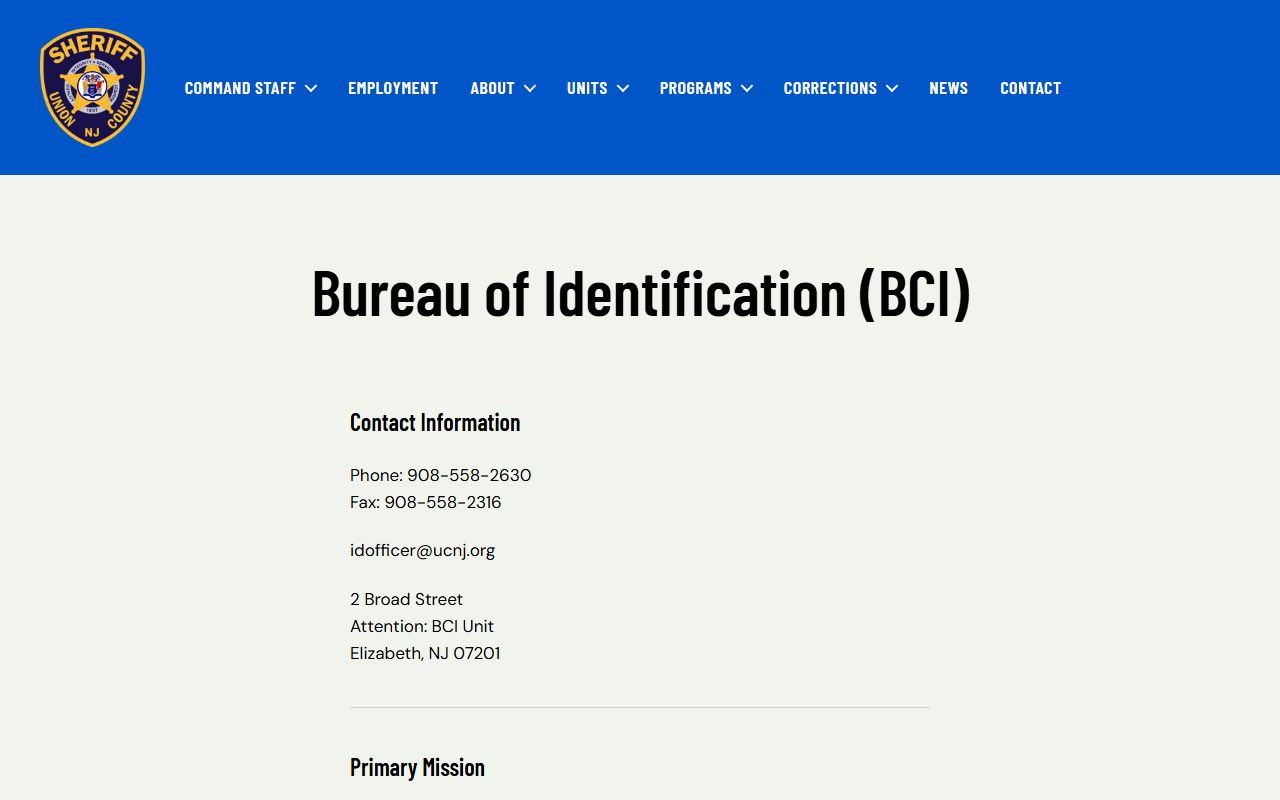
Data is recorded during arrest, at first appearance, or after a conviction and sentence.
- Check the Sheriff's inmate lookup to see if the person is in current custody.
- Search the NJ Courts Criminal Judgments Public Access portal by defendant name, SBI number, complaint number, or indictment number.
- Set the county to Union when the portal allows it.
- For employment or licensing, order a State Police criminal history record check instead of a casual lookup.
The Union County Booking Process
An arrest record reflects a chain of steps. Knowing the chain helps you read the record and find the right office. The process starts with the arrest and ends with the person either released or moved into custody and produced for court.
- A local, state, or federal officer makes the arrest.
- The person is transported to jail intake for processing.
- Staff take fingerprints, a photo, and pedigree data through the Bureau of Criminal Identification and live scan.
- The complaint is filed as a complaint-warrant or a complaint-summons.
- A first appearance and pretrial release review follow under New Jersey's criminal justice reform.
- Classification and medical screening lead to housing or transfer.
Indictable offenses are handled by the Superior Court Criminal Division. Lesser offenses, such as disorderly persons and petty disorderly persons matters, are handled in Municipal Court. The charging document is an indictment when a grand jury acts, or an accusation when a defendant waives indictment.
Arrest Records vs. Criminal Court Records
The two records cover different stages. The arrest record captures the booking event. The court record captures the legal case that may follow. One can exist without the other. A person may be arrested and released without charges, or charged by summons without a custodial booking.
| Arrest Record | Criminal Court Record | |
|---|---|---|
| Source | Police, Sheriff, BCI | Superior Court Criminal Division |
| Created When | At booking | When charges are filed |
| Contents | Booking data, charges, photo, prints | Complaint, motions, plea, disposition |
| Where to Find | Jail lookup, BCI | NJ Courts case and judgment search |
Mugshots and Booking Photos
A booking photo, or mugshot, is taken at intake along with fingerprints. In New Jersey, booking photos are part of the criminal-justice record held by the arresting agency and the Bureau of Criminal Identification. They are not posted on an open county gallery. Access depends on agency policy and on whether a record has been expunged, which pulls the photo from public reach.
Be careful with third-party mugshot sites. They are often out of date and may show people whose cases were dropped or cleared. Some charge a fee to take a photo down, which the official agencies do not. The booking record held by the arresting agency and the Bureau of Criminal Identification is the reliable source.
Charges vs. Convictions
This difference matters more than any other in an arrest record. A charge is an accusation. A conviction is a finding or plea of guilt. Many charges are dismissed, downgraded, or end in acquittal. Reading an arrest as a conviction is a common and serious mistake.
| Charge | Conviction | |
|---|---|---|
| Stage | Accusation at or after arrest | Verdict or guilty plea |
| Burden of Proof | Probable cause | Beyond a reasonable doubt |
| Public Record | Yes, unless restricted | Yes, unless expunged |
When you read a record, watch the disposition line. It tells you how a charge ended. A case may be dismissed, downgraded, resolved by plea, or end in an acquittal. "Dismissed" means the charge was dropped. An acquittal means a not-guilty result. Pretrial Intervention, a diversion program for some first-time defendants, can end in dismissal without a conviction. So a single arrest can list several charges that resolve in very different ways, and only the disposition shows the true outcome of each one.
Statewide Criminal Records and Reporting
For convictions, the NJ Courts Criminal Judgments Public Access portal searches judgments of conviction, orders for commitment, and judgments of acquittal or dismissal. You search by defendant name, SBI number, complaint number, or indictment or accusation number. For a full criminal history, the New Jersey State Police handle fingerprint-based record checks used in employment and licensing.
The Union County Prosecutor's Office, led by William A. Daniel, prosecutes state crimes in the county. It joined the County Police Chiefs and Crime Stoppers to fight car thefts and burglaries, with rewards up to $10,000 for tips that lead to an arrest and indictment.
That partnership is described in a Union County Prosecutor press release.

The anonymous tip line is 908-654-TIPS (8477), and tips can also go through UCtip.org.
Sealed vs. Expunged Records
New Jersey leans on expungement more than sealing. A sealed record is closed to the public by a court order under the access rules. An expunged record is isolated under N.J.S.A. 2C:52, which treats eligible records as removed from ordinary public access. Expungement can reach complaints, warrants, arrests, fingerprints, photographs, rap sheets, and court docket records.
The NJ Courts expungement self-help page walks through who qualifies and how to file.
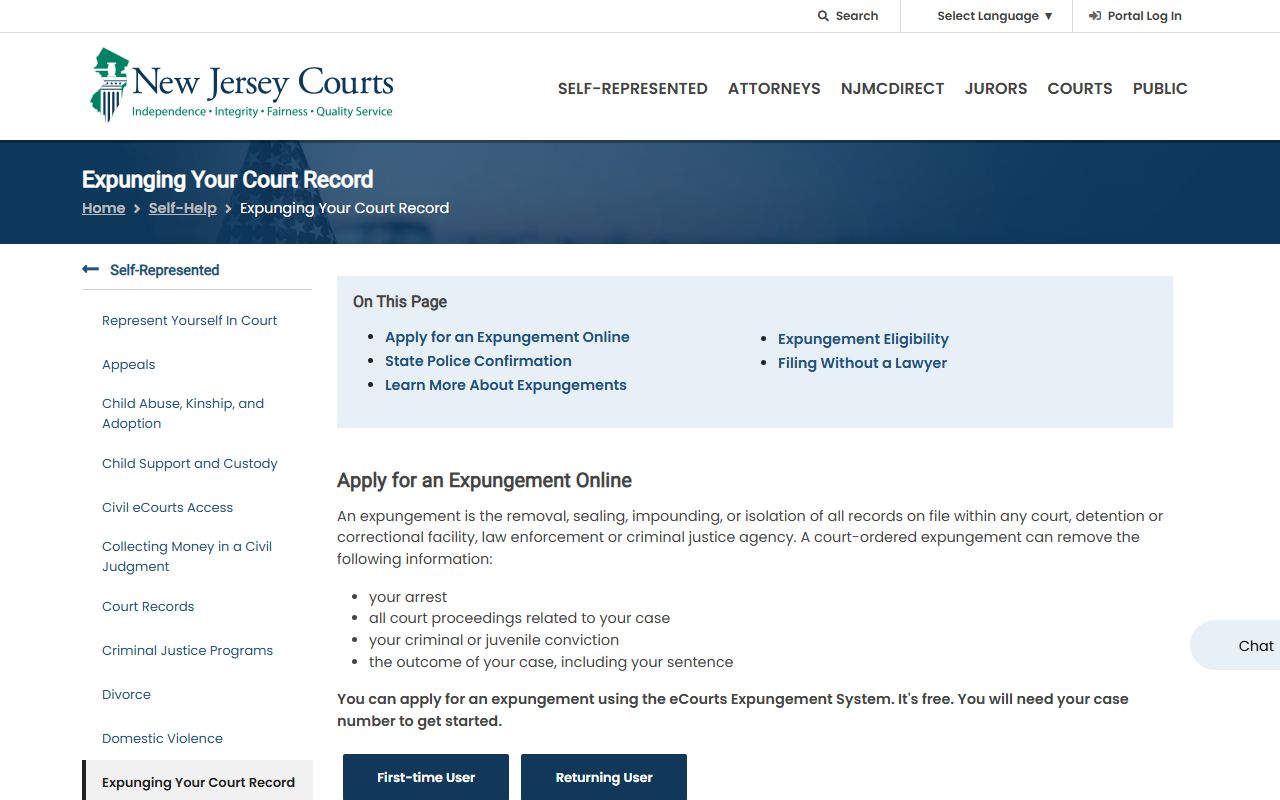
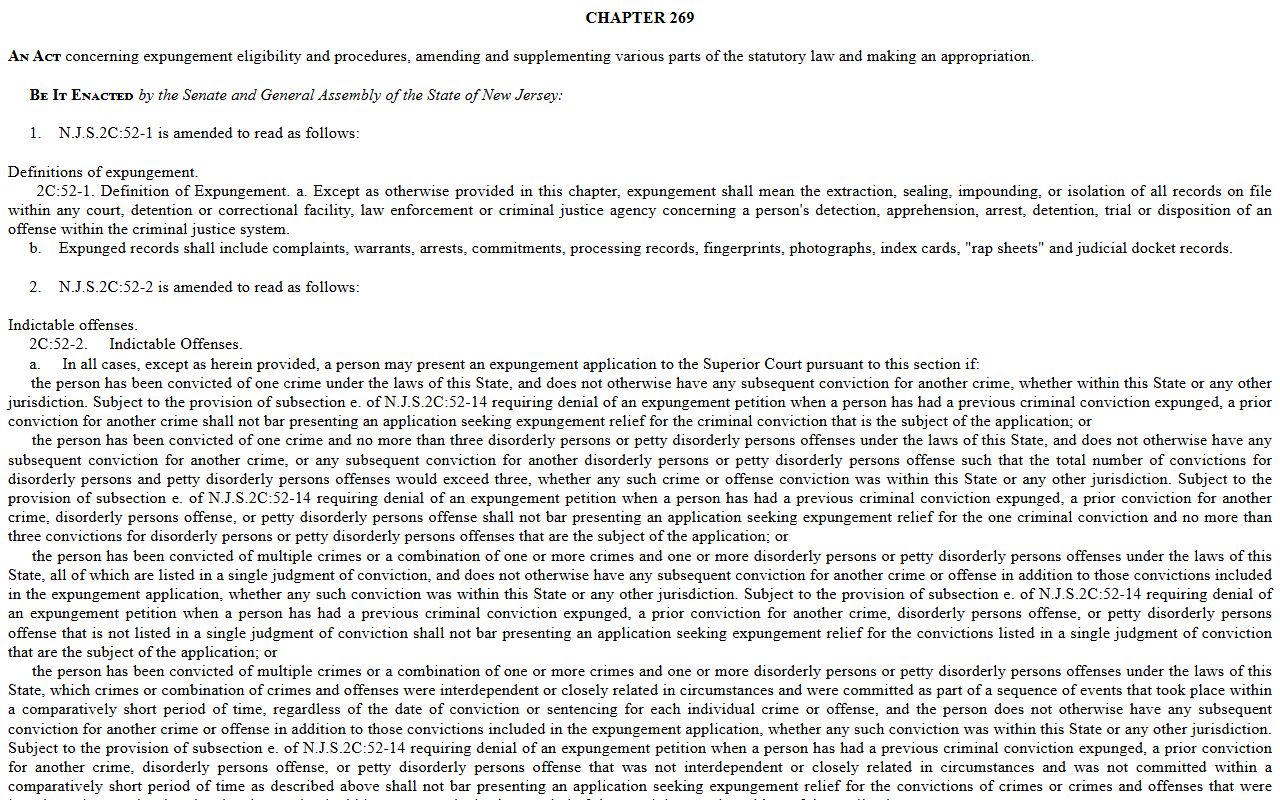
Eligibility depends on the offense, the waiting period, the number of convictions, and whether the sentence is complete. The 2019 reform expanded this framework, including clean-slate and marijuana provisions.
The amended law text appears in Public Law 2019, c.269.
| Sealed | Expunged | |
|---|---|---|
| Authority | Court order under access rules | N.J.S.A. 2C:52 |
| Public Visibility | Closed to the public | Isolated from public access |
| Law Enforcement | Limited access | Very limited, by statute |
| Eligibility | Case-specific, by motion | Offense, waiting period, conviction count |
Background Check Considerations
A casual name search is not a legal background check. Employers, landlords, and licensing bodies must follow the federal Fair Credit Reporting Act and use a proper consumer reporting agency. A fingerprint-based State Police check is the accurate path for those uses. Free public lookups are fine for general awareness, not for hiring or housing decisions.
Important: This site is not a consumer reporting agency under the FCRA, and its information cannot be used for employment, credit, tenant, or insurance decisions.
Restricted Arrest Records in Union County
Some arrest data is closed. Juvenile records are safeguarded under N.J.S.A. 2A:4A-60, which keeps most juvenile court, police, and social records out of public view. Expunged matters are removed from public portals. Records tied to an active investigation may be withheld. Personal identifiers like Social Security numbers are redacted from any public file.
If a record should have been cleared but still appears, the expungement order is the tool to fix it. Knowingly revealing an expunged record outside permitted limits is itself an offense under the expungement law.
Who Prosecutes and Who Defends Cases
The Union County Prosecutor's Office is the county's largest law office and one of its largest police agencies, with more than 250 assistant prosecutors, investigators, forensic staff, and victim-witness advocates. It handles grand jury and indictment work, trials, appeals, and special victims cases. Prosecutor William A. Daniel was sworn in on July 14, 2021. Federal crimes are not prosecuted here; the U.S. Attorney for the District of New Jersey handles those.
An official county page describes the Prosecutor's office and its scale.
It confirms Prosecutor William Daniel was sworn in on July 14, 2021, and that the office runs with more than 250 staff.
Defendants who cannot afford a lawyer can ask the court about the Office of the Public Defender or court-appointed counsel. For municipal matters, NJ Courts uses a Financial Questionnaire to Establish Indigency, form CN 10110, to test whether a person qualifies. Ask at the first appearance or in the Criminal Division about applying.
Victims have resource lines too, including the statewide domestic violence hotline at 1-800-572-7233 and the sexual violence hotline at 1-800-601-7200.